 Simpleswap
Simpleswap refunds for interrupted exchanges and deposit errors
Simpleswap refunds can return an eligible deposit when an exchange cannot proceed, subject to review, network costs and an accepted return address. Some compliance-stopped swaps qualify for automatic returns; other cases require a refund request. Processing status and deposit errors affect eligibility. A failed order does not establish that the full deposit will reach your wallet.
The deposit asset, return destination and reason for interruption shape the available options. Keep the order record separate from its blockchain transactions, especially when funds came from an exchange account or a partner wallet.
Automatic returns and support-reviewed refund requests
Automatic returns cover eligible swaps that cannot proceed after additional compliance screening. This mechanism sends qualifying deposits to the refund address without requiring a support ticket. It deducts the standard network fee without adding a service charge. Supported assets and networks limit availability. In API integrations, the mechanism must be enabled and the partner must provide a refund address. For an interrupted swap outside that scope, request a refund assessment from Simpleswap support.
A partner wallet can supply the user’s refund address or a partner-controlled destination and settle with the user separately. This changes who receives the initial return. A transfer to the partner does not establish a credit to the user’s wallet. When the exchange originates inside another application, retain that application’s order reference alongside the Simpleswap Exchange ID. Ask who handles the final credit if the partner receives the returned funds.
Processing status and cancellation limits
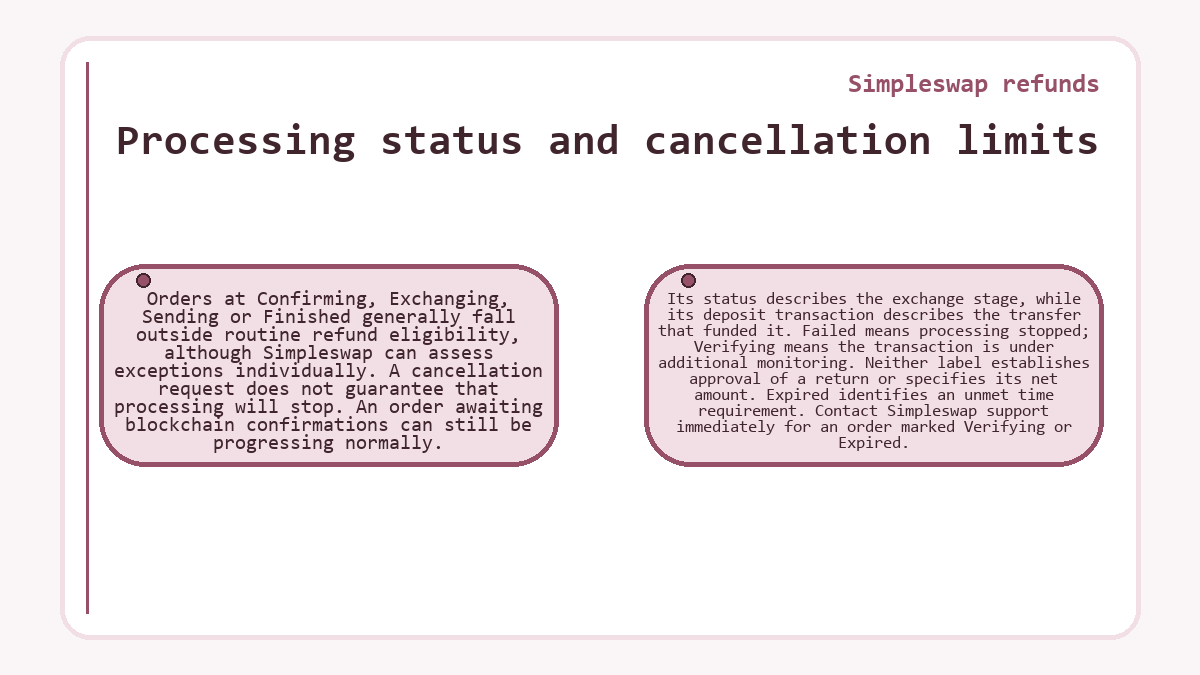
Orders at Confirming, Exchanging, Sending or Finished generally fall outside routine refund eligibility, although Simpleswap can assess exceptions individually. A cancellation request does not guarantee that processing will stop. An order awaiting blockchain confirmations can still be progressing normally. Its status describes the exchange stage, while its deposit transaction describes the transfer that funded it. Failed means processing stopped; Verifying means the transaction is under additional monitoring. Neither label establishes approval of a return or specifies its net amount. Expired identifies an unmet time requirement. Contact Simpleswap support immediately for an order marked Verifying or Expired.
How long can a refund request take?
The refund-request policy sets a processing period of up to 31 calendar days for support-reviewed requests. Eligibility determines whether a return can proceed; this period does not promise a refund for every deposit. Eligibility review and the eventual blockchain transfer are distinct parts of the case. Keep the request date and support responses so that a follow-up identifies the unresolved issue precisely.
Eligible automatic screening returns normally complete in 5 to 15 minutes. Busy networks can extend this to 30 minutes. These operational estimates apply to that automatic mechanism. They do not set a deadline for every compliance review, technical recovery or legally frozen deposit. If support gives a case-specific estimate, distinguish review time from the time needed for transfer confirmation.
Return addresses and exchange-account withdrawals
A refund destination needs to support the returning asset on the network used for the refund. The address selected for the swapped output may support a different asset or network, so it is not automatically suitable.
Control of the receiving address
Self-custody wallets
A self-custody receiving address belongs to a wallet whose owner controls its keys. Confirm that the wallet supports the returning asset on the selected network. A familiar address format cannot establish compatibility by itself. Different networks can use similar formats. Keep the complete receiving address intact when providing it, and compare it with the destination that support confirms.
Custodial exchange accounts
An exchange withdrawal can originate from its own wallet, separate from your personal deposit address. Returning funds to that sending address may deliver them to exchange infrastructure without crediting your account. Recovery can require the receiving exchange’s intervention and may be unavailable. Obtain receiving details from the account’s deposit instructions, including any required memo or tag. The account balance and the blockchain transfer remain separate records.
The destination that Simpleswap accepts
Without a designated refund address, Simpleswap treats the original sending address as the refund destination. It may restrict a return to that original address even if you supplied another destination. Confirm which address support will use before it transfers the returned funds. Supplying a compatible address establishes a proposed destination; it does not establish approval to use it.
Deductions and the amount that reaches the wallet
Network costs can reduce the amount that returns, so the deposit and the final wallet credit need not match. Simpleswap may deduct the network fee for the return transaction from the original deposit. Compare amounts in the returning asset, keeping the original swap’s receiving estimate separate. That estimate concerns the intended exchanged asset and does not specify the quantity of the deposit asset that comes back.
The network, asset and congestion affect transaction costs, and an initial fee estimate can change before the transfer. Ask whether a quoted charge is a deduction or a separate payment. Exceptional fund recovery can involve additional charges from Simpleswap or a service provider. Identify those charges before accepting the proposed return amount. A quoted network deduction does not establish whether separate recovery work is necessary.
Deposit mistakes and recovery eligibility
Wrong assets, incorrect networks and missing mandatory identifiers generally fall outside refund eligibility when they breach the order instructions. The refund policy also excludes deposits involving an expired contract. Counterfeit assets, test-network deposits and assets involved in illicit activity fall outside refund eligibility. A visible transfer record does not establish that the service can access, exchange or return what arrived.
An incorrect deposit amount needs a separate assessment. Simpleswap may cancel an underfunded or overfunded order and offer a return when the transferred amount exceeds the network fee. Sending below the displayed minimum can leave the exchange unsuccessful without an assured refund. A positive balance after a fee calculation does not establish eligibility: the order’s asset, network and funding instructions still apply. Technical recovery, where possible, can introduce another cost.
Rate changes and a return instead of a new quote
A late fixed-rate deposit can lead to a refund offer or a revised rate if the original rate has changed. If the rate remains unchanged, the exchange can proceed at that rate. The relevant funding conditions include the required deposit confirmation within the rate-lock window. Missing those conditions does not automatically select a refund. Establish whether support proposes returning the deposit or completing the exchange under different terms.
A floating-rate estimate can change during processing. A significant difference can prompt Simpleswap to pause the exchange and offer a refund or request approval for the revised receiving amount. These options concern different assets and costs. Continuing converts the deposit into the requested output; a return sends the deposit back under the applicable refund conditions. Compare the actual offer without treating an earlier receiving estimate as an amount owed on a refund.
Compliance checks and frozen-fund returns
Know Your Customer (KYC) checks can require identity information and evidence about the source of funds. Anti-money laundering (AML) screening assesses transaction risk, including history that may precede the current sender. A paused exchange does not establish wrongdoing. Eligible automatic returns coexist with reviews that need additional information. Identify whether the case concerns an automatic screening return, ownership verification or an investigation into frozen assets.
The separate frozen-fund return procedure requires identity and ownership documentation. The September 7, 2026 Terms of Service set its administrative charge at 1% of the returned amount, with a $100 minimum. That charge belongs to the frozen-fund procedure and does not apply universally to ordinary refunds. A court-ordered freeze can keep assets blocked until the authority resolves the case or directs their release. An automatic-return estimate cannot override that restriction.
Matching the support request to the deposit
The Exchange ID identifies the order; the transaction ID (TXID) identifies a blockchain transfer. Support commonly needs both after funding. Include the deposit asset and network, the actual amount transferred and the requested return destination. Where relevant, include the memo or tag. Keep the deposit TXID separate from any later refund TXID so that each record identifies the correct transfer.
Ownership review may require more than the transaction record, including account statements or other supporting documents. Contact Simpleswap through its own support form, live chat or support email, using a channel that you open yourself. A person who knows the deposit amount or TXID has not established authority to handle the refund. Unsolicited recovery messages can reuse genuine case details. Keep Exchange IDs and identity documents out of public complaint posts.
A request for a fee needs confirmation through the support channel handling the case. A plausible explanation about network costs is insufficient on its own.
Refund support does not need a recovery phrase or private key. Those credentials control the wallet and cannot serve as ordinary refund documentation.
Reconciling a hypothetical return estimate
In this hypothetical case, all amounts and case conditions are illustrative. A customer chooses a refund for an eligible deposit of 18.78 units of the network’s native coin instead of accepting a revised exchange quote. The return address is compatible, and no recovery charge applies. Support initially estimates a return network fee of 0.018 coin units, giving an estimated return of 18.762 units.
Before accepting the proposed return, the customer asks support to confirm the destination and net amount. The network fee estimate changes to 0.028 units. The updated proposed return becomes 18.752 units: 18.78 minus 0.028.
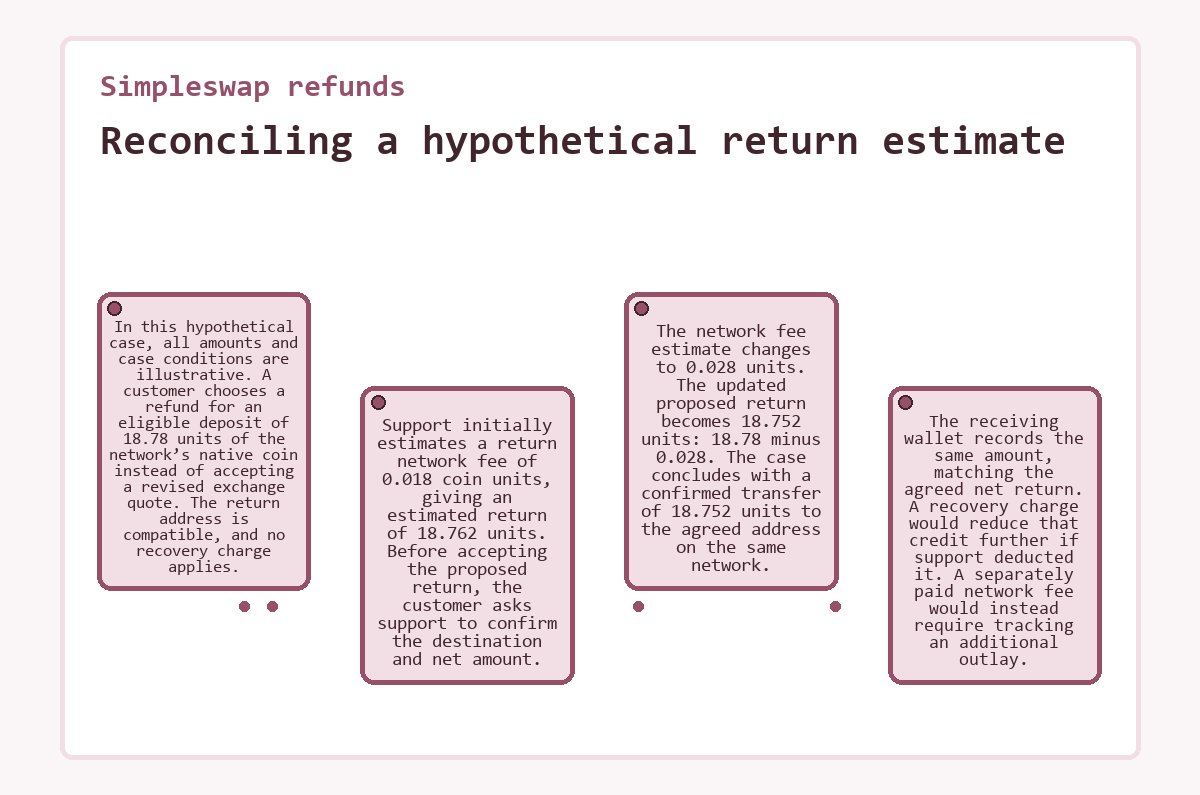
The case concludes with a confirmed transfer of 18.752 units to the agreed address on the same network. The receiving wallet records the same amount, matching the agreed net return. A recovery charge would reduce that credit further if support deducted it. A separately paid network fee would instead require tracking an additional outlay.
When has a refund actually reached the wallet?
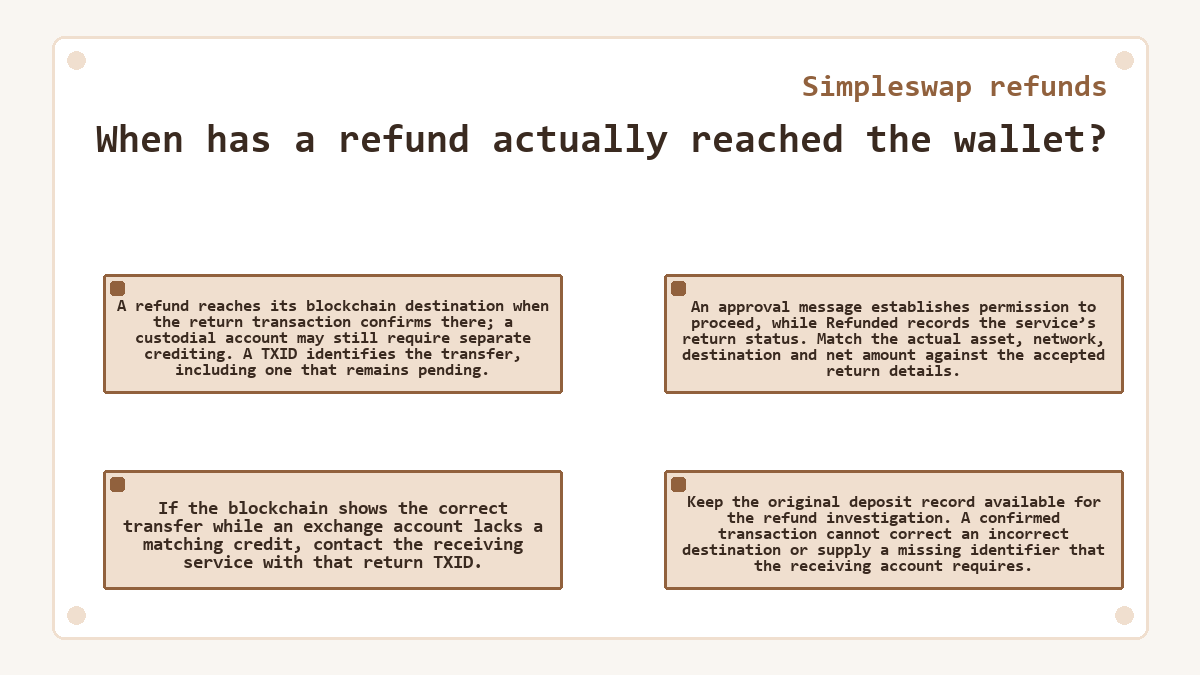
A refund reaches its blockchain destination when the return transaction confirms there; a custodial account may still require separate crediting. A TXID identifies the transfer, including one that remains pending. An approval message establishes permission to proceed, while Refunded records the service’s return status. Match the actual asset, network, destination and net amount against the accepted return details.
If the blockchain shows the correct transfer while an exchange account lacks a matching credit, contact the receiving service with that return TXID. Keep the original deposit record available for the refund investigation. A confirmed transaction cannot correct an incorrect destination or supply a missing identifier that the receiving account requires.
What to know about Simpleswap refunds
Does a refund repay the fee that my sending wallet charged?
A deposit refund does not automatically reimburse the network fee that funded the original transfer. That fee pays for sending the deposit and is separate from the amount that the deposit address received. Read the wallet debit, deposited amount and proposed refund as separate quantities. Any additional reimbursement would need explicit confirmation for the case.
Why can a token refund require the network’s native coin?
A token return can require a separate payment in the network’s native coin to cover its transaction fee. The refund policy permits this in some token cases because the returned token differs from the network’s native asset. Confirm the specific amount and payment instructions through the support channel handling your case. This provision does not make an unsolicited payment demand legitimate.
Will another transfer to the same deposit address repair my failed order?
Another transfer does not automatically repair or reopen a failed order. Simpleswap assigns the deposit address to a specific exchange and instructs users not to reuse it for another transaction. A further deposit can create a separate mismatch, and refund availability is not assured. Ask support how it will handle the existing funds before sending anything else.
Are identity records deleted after a refund finishes?
Completing a refund does not automatically delete identity records. Retention depends on the type of record and the review involved. The AML/KYC policy requires retaining suspicious-transaction information, including personal data, for at least five years or longer where authorities require it. That retention condition concerns those reviewed transactions; it is not a claim that every refund collects the same identity documents.
Is there a time limit for reclaiming an unresolved deposit?
Simpleswap limits its stated holding period for user funds to one calendar year and does not guarantee recovery of unclaimed funds afterward. This concerns unclaimed balances, not the processing estimate for an active refund request. Keep your contact details usable and respond to ownership questions while the case remains unresolved.
Which refund rules apply to a card-funded crypto purchase?
A card-funded purchase requires checking the payment provider’s transaction and refund rules. Simpleswap offers fiat purchases through third-party providers, which handle payment processing and their own verification requirements. Keep the purchase reference and identify the provider that processed the payment. A crypto-swap refund address does not by itself specify how that provider will resolve a card-payment dispute.